30.07.2026
Future of Lithography Logistics: HERO Scout Proven in Real-World Cleanroom Operations
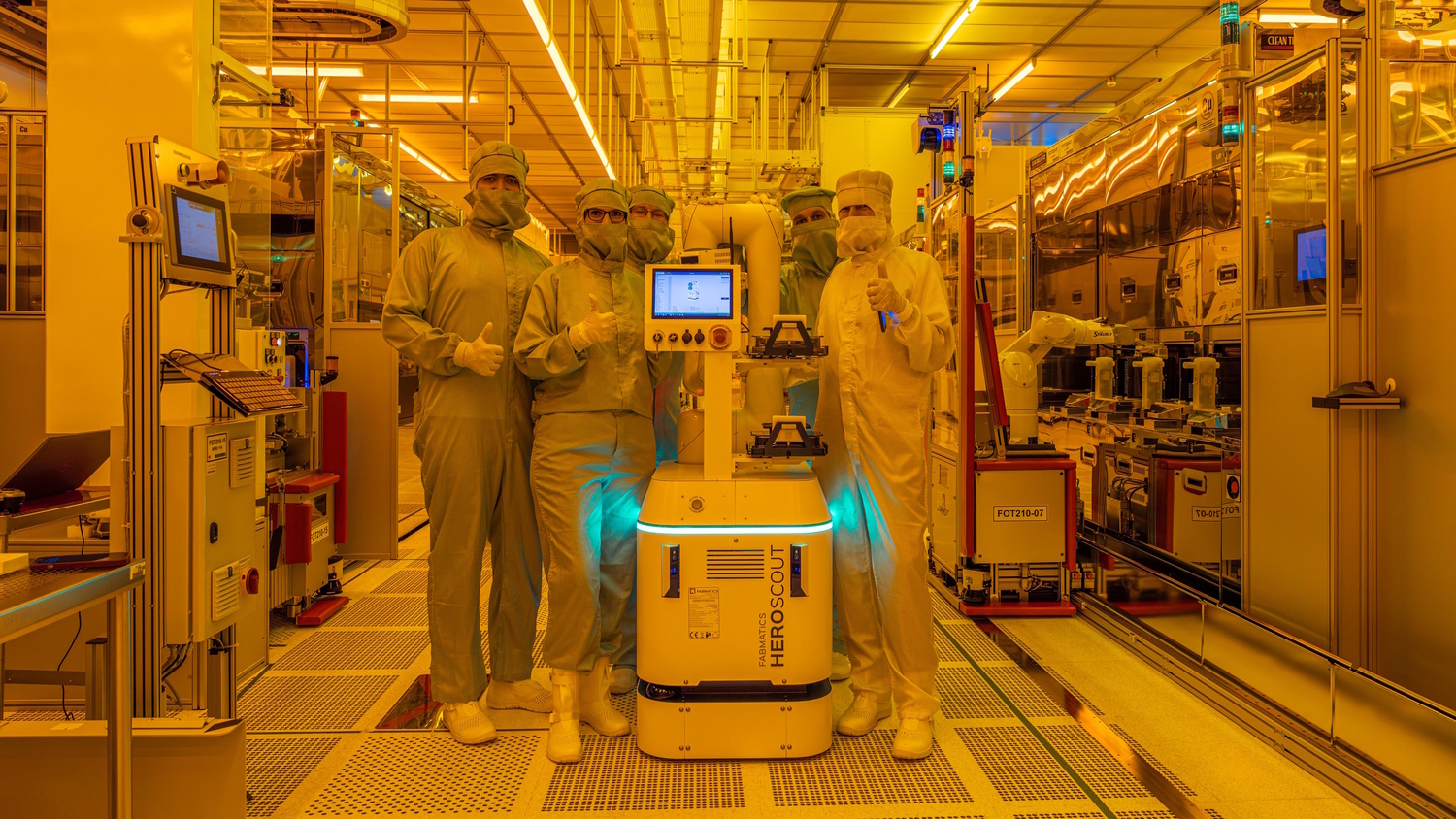
As part of the European research project AIMS 5.0, Fabmatics and Infineon Technologies Dresden have successfully evaluated the new autonomous mobile robot (AMR) HERO Scout under real production conditions in a 200 mm semiconductor fab. During the trial, the AMR performed fully automated transport and handling of reticle SMIF pods and 200 mm wafer carriers in lithography operations, including navigation through narrow cleanroom aisles, high-speed movements, and complex handling scenarios.
The results demonstrate that HERO Scout is technically ready for deployment in highly automated and digitalized semiconductor fabs and makes a significant contribution to the objectives of the AIMS 5.0 initiative.
AIMS 5.0: AI-Driven Automation for the Industry 5.0 Factory
AIMS 5.0 (Artificial Intelligence in Manufacturing leading to Sustainability and Industry 5.0) is one of Europe's key semiconductor initiatives aimed at strengthening digital sovereignty and advancing next-generation manufacturing technologies. Between 2023 and 2026, a consortium of 53 partners from 12 countries is developing AI-enabled components, software platforms, and automation solutions for more productive, resilient, and sustainable industrial manufacturing.
Coordinated by Infineon Technologies, the project includes several technology demonstrators that are validated directly in real production environments, ranging from AI-supported process optimization to autonomous cleanroom logistics. Fabmatics plays a leading role in the work areas "Smart Transport & Storage Concepts for Future AI-Based Automation Systems" and "AI-Based Control & Virtual Commissioning for Mobile Systems." In addition to advanced storage solutions such as the FlatStocker 3.0 and digital twins for automation systems, Fabmatics is developing a next-generation mobile robotic platform featuring AI-capable control software and auto-teaching functionality for semiconductor applications such as reticle logistics: the HERO Scout.
Reticle Logistics: A Critical Process in Semiconductor Lithography
Lithography is one of the most complex and cost-intensive operations in semiconductor manufacturing. Photomasks, also known as reticles, are used to transfer highly precise micro- and nanostructures onto wafers through multiple process layers. Any delay or supply interruption at lithography tools directly impacts throughput, overall equipment effectiveness (OEE), and fab yield.
As a result, reticle logistics must be as reliable and synchronized as wafer transport. Manual handling of reticle pods and wafer carriers introduces risks such as errors, delays, and ergonomically challenging working conditions. This is precisely where the AIMS 5.0 use case comes into play: enabling autonomous, highly precise reticle transport through an AMR that can be seamlessly integrated into existing cleanroom infrastructures.
HERO Scout: Compact AMR for Precise Reticle and Wafer Handling
The HERO Scout is an autonomous mobile robot specifically developed for semiconductor cleanrooms. Equipped with an integrated six-axis collaborative robotic arm, the system was designed jointly by Fabmatics and Infineon Dresden to meet practical requirements for functionality, performance, maintainability, cost efficiency, and flexibility in lithography environments.
Key technical features include:
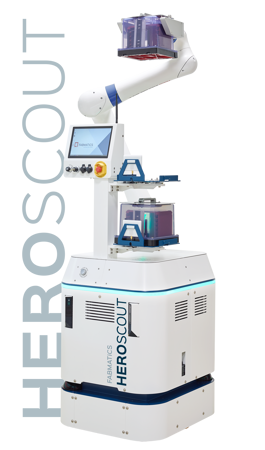
- Compact footprint (approximately 66 × 56 cm) for operation in narrow and highly constrained cleanroom areas.
- Extended reach and payload capacity (from about 200 to 1,700 mm), enabling access to elevated load ports with payloads of up to 20 kg.
- Active vision-guided gripper with adaptive grippers for reticle pods and open wafer cassettes, camera-based position detection, and 6D offset correction for reliable handling even when load ports have been repositioned.
- Advanced 3D vision and safety systems capable of detecting obstacles such as chairs, workstations, displays, keyboards, and floor openings. Safety features with sensitive collision detection enable safe operation in areas with frequent personnel traffic.
- High driving dynamics with vibration control, reaching speeds of up to 1.2 m/s while maintaining stability on perforated raised floors.
- Inductive charging and auto-teaching capabilities, enabling on-the-fly charging, rapid deployment through SLAM-based navigation and automated route learning.
On the software side, Fabmatics developed a new AI-enabled local control architecture that allows HERO Scout to operate as an intelligent autonomous unit within the fab. In parallel, the company's fleet management system has been enhanced with AI capabilities to support future AMR fleet coordination, including dynamic route planning and intelligent task allocation.
Real-World Validation in Infineon's 200 mm Fab
To validate the HERO Scout concept, a prototype system was deployed in the 200 mm lithography production environment at Infineon Dresden. Testing focused on key operational scenarios, including:
- Transport and handling of reticle pods and wafer carriers
- Navigation through complex cleanroom layouts
- Interaction with dynamic obstacles and personnel traffic
- Operation in highly constrained spaces
- Evaluation of driving stability at elevated speeds
Tests were conducted using dummy materials to replicate realistic operating conditions without affecting production processes. Throughout all scenarios, HERO Scout demonstrated highly reliable navigation performance, even in dynamic and narrow cleanroom environments. Its vision-guided gripping system proved robust against load port position deviations and enabled precise handling without re-teaching. The evaluation also confirmed safe interaction with personnel and obstacles, while vibration measurements remained well below relevant operational limits. Furthermore, several optimization opportunities were identified to further enhance the system without affecting its overall readiness for industrial deployment.
Advancing Semiconductor Factory Automation
The successful field evaluation at Infineon Dresden provides a tangible industrial demonstrator for the AIMS 5.0 program and highlights the potential of autonomous logistics within semiconductor manufacturing. The project delivers:
- Automated reticle transport as a key lever for improving lithography OEE.
- A scalable AMR platform featuring AI-enabled control architecture and fleet management capabilities.
- Seamless integration into existing fab layouts without requiring major infrastructure modifications.
Looking ahead, HERO Scout will enable semiconductor manufacturers to gradually transition reticle and wafer logistics from manual handling toward fully autonomous operations. Combined with other AIMS 5.0 developments such as digital twins and AI-driven fleet orchestration, the solution represents an important building block for the intelligent, connected, and sustainable factories of the future, developed in Europe.
About AIMS 5.0

The AIMS5.0 project is supported by the Chips Joint Undertaking and its members, including top-up funding from the national funding authorities of the participating countries under Grant Agreement No. 101112089.
About Fabmatics:
Fabmatics GmbH, headquartered in Dresden, Germany, is a leading specialist for the automation of material flows and handling processes in the semiconductor industry and other high-tech manufacturing environments. Since its foundation in 1991, the company has successfully delivered customized automation solutions worldwide and has established a strong market position, particularly in the modernization of 200 mm semiconductor fabs.
The company's portfolio comprises a modular range of hardware and software solutions for handling, transport and storage processes, as well as systems for product identification and tracking. These include mobile robots, robotic cells, cleanroom storage systems, RFID technologies and purge systems that increase efficiency, speed and process reliability in manufacturing operations. Fabmatics combines all key competencies for cleanroom material handling automation from a single source.
With approximately 300 employees and a subsidiary in the United States, Fabmatics operates on a global scale. Since 2023, the company has been part of the SCIO Automation Group, which provides intelligent automation solutions for leading industrial companies across eight countries. Fabmatics is also an active member of international and regional industry networks such as SEMI, Silicon Saxony and the AND Automation Network Dresden.