
Validate your automation system before implementation with automation system modeling approach

Making better automation decisions starts with understanding your system

Semiconductor fabs operate in highly complex environments where automation decisions influence throughput, cycle time, capacity, and long-term scalability.


External Content

Please accept "External Media" cookies to see the content.

I accept the display of external media and the transfer and processing of personal data according to the privacy policy.


Fabmatics helps semiconductor manufacturers plan, validate, and optimize automation systems using Automation System Modeling. By combining analytics, simulation, and digital twins, we help teams make data-driven decisions before systems or changes are implemented.

The Challenge:
Understanding system behavior is harder than it seems

In semiconductor fabs, automation systems are typically designed with a high level of engineering rigor. Layouts are carefully planned, transport concepts are defined, and system components are dimensioned based on expected requirements. At this level, decisions often appear well-founded.

However, system performance is not determined by individual elements, but by how these elements interact under real operating conditions.

System Behavior is influenced by:

  • ✓ the interaction between process tools, transport systems, and buffers
  • ✓ time-dependent effects such as sequencing, queuing, and variability
  • ✓ fluctuations in workload, demand, or system states

The Gap:
Limited visibility into dynamic system behavior

In reality, automation systems are dynamic:

  • material flows evolve over time
  • resources interact across multiple system layers
  • system behavior changes with workload and variability

These interactions are difficult to fully capture using static planning approaches alone.

Typical Issues:

  • Oversimplified analysis → hidden interdependencies
  • Overly complex models → long timelines without better decisions
  • Missing validation → risks appear during implementation
  • Misleading KPIs → wrong conclusions
 

Automation system performance is the result of a continuous interaction between real-world conditions, engineering decisions, and digital evaluation.​

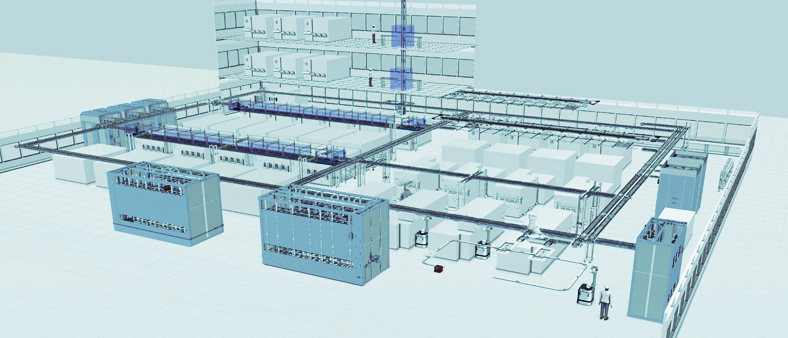
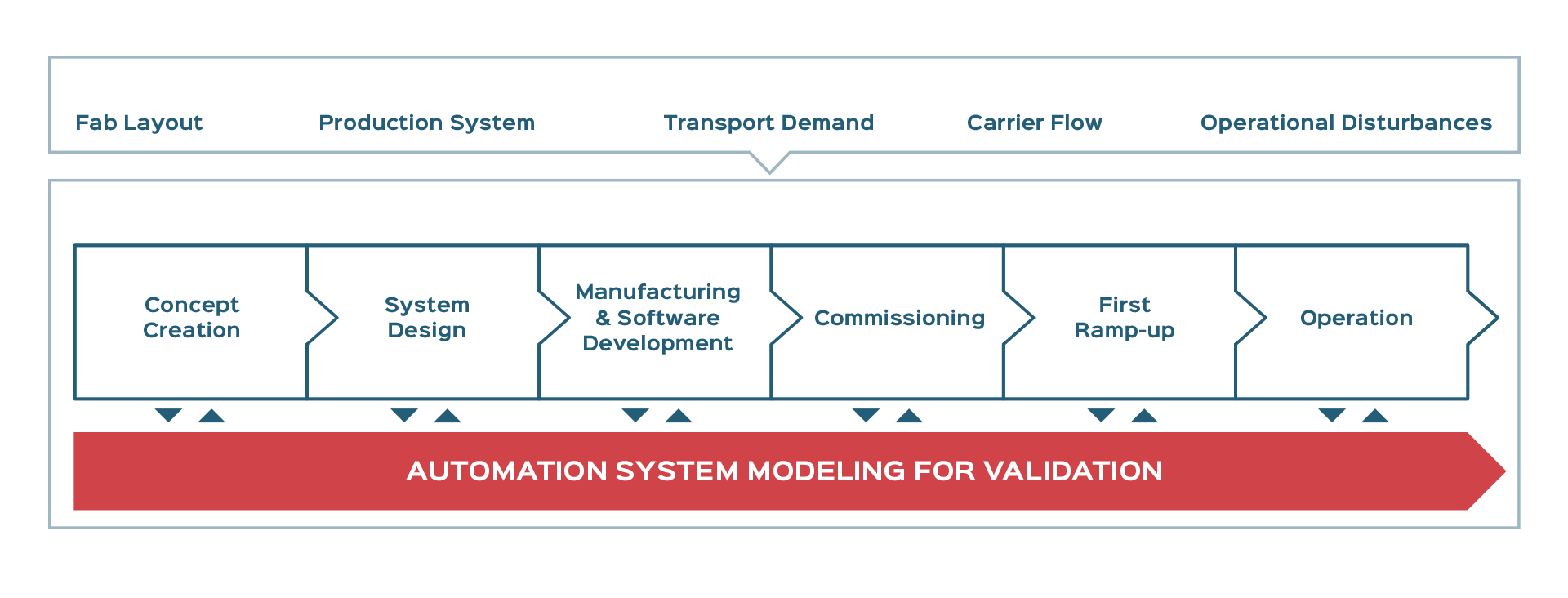
Automation system modeling across all project phases from concept to operation for system validation

The key to successful automation projects is a structured, method-driven approach.


Our Solution:
Automation System Modeling

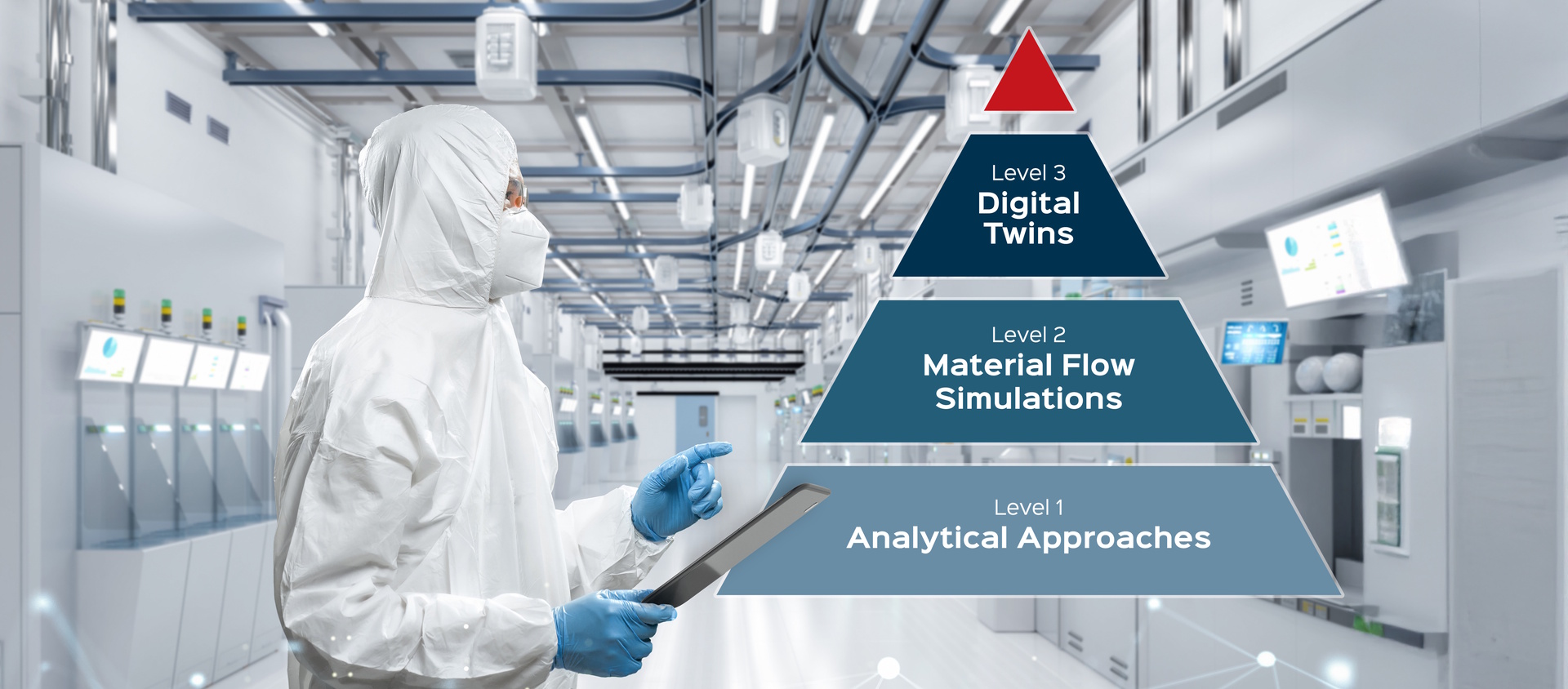
Automation System Modeling is our data-driven methodology to plan, validate and optimize automated material handling systems across their lifecycle. Instead of relying on a single tool, Fabmatics combines the right methods based on the specific question, the required level of insight and the project phase.


Automation system modeling pyramid with analytical approaches, material flow simulation and digital twin levels

Analytical Approaches​

For Speed & Understanding

Analytical approaches use mathematical and statistical models (e.g., queuing theory) to quickly evaluate automation system behavior with minimal input data.

They enable fast, transparent insights into system limits, capacity requirements and bottleneck conditions, especially in early project phases or when rapid decisions are required.

Unlike simulation, analytical methods focus on understanding cause-and-effect relationships rather than reproducing full system behavior.

Capacity & Throughput Analysis

  • Determine theoretical and practical throughput limits of automation equipment (e.g. a robot cell)
  • Identify bottlenecks early in the design phase

Buffer & Inventory Sizing

  • Define minimum buffer sizes for reliable material supply
  • Balance service level, cost and system stability

Infrastructure Dimensioning (e.g. AMR charging)

  • Size charging infrastructure and supporting systems
  • Optimize cost vs. operational availability

Fast results ​with limited data availability

  • Quick calculations without long runtimes, especially helpful for evaluation in early design phases​

Lower setup effort​

  • No complex model building and simulation needed​

Clear insights​ into system relationships and assumptions

  • Understand cause-effect relationships​

Best for stable systems​

  • Works well in predictable environments​

Easy Communication​

  • Simple to explain and justify

Material Flow Simulations

For Validation & Decision Support

Material flow simulation replicates the dynamic behavior of semiconductor automation systems under realistic operating conditions.

It models interactions between equipment, transport systems and control logic, enabling quantitative evaluation of system performance, robustness and scalability across a wide parameter space.

Simulation is typically executed as a Design of Experiments (DoE) to ensure statistically valid and robust decision-making.

Automation Concept & Layout Evaluation

  • Compare alternative layouts, storage systems and transport technologies
  • Identify optimal solutions before detailed engineering

Performance & Capacity Analysis

  • Evaluate throughput, utilization and system limits
  • Identify bottlenecks and critical resources

Fleet Sizing & Resource Optimization

  • Dimension AMRs, vehicles and infrastructure
  • Optimize cost vs. service level and performance

Robustness & Sensitivity Analysis

  • Evaluate system behaviour under varying demand and disturbances
  • Identify robust design solutions

Failure & Recovery Scenarios

  • Test resilience under equipment failures or startup conditions
  • Validate system stability and recovery performance
✔ Realistic representation of complex system interactions

Data-driven comparison of multiple design options

Identification of bottlenecks and hidden dependencies

Enables robust decision-making across parameter ranges

Significant reduction of design and investment risk

Digital Twins

For Lifecycle Optimization & Execution

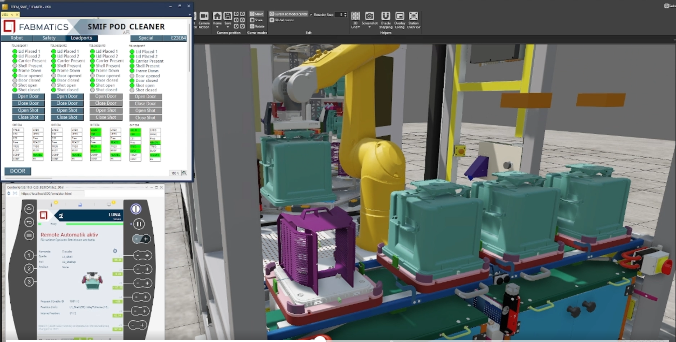
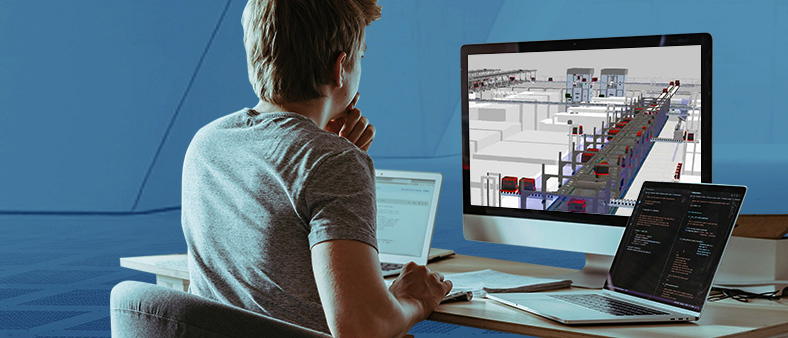
A digital twin is a high-fidelity, continuously maintained virtual representation of a real automation system, including both physical structure and control logic.

It enables real-time monitoring, virtual testing and lifecycle optimization, acting as a central engineering model from planning through ramp-up and full production.

The digital twin is continuously linked to the physical system, combining real operational data with the actual automation and control logic throughout the system lifecycle.

Virtual Commissioning

  • Validate PLC logic, robot behavior and safety concepts before installation
  • Shift commissioning activities into early project phases

Real-Time Monitoring & Performance Tracking

  • Create live representation of system status and material flow
  • Increase operational transparency

What-If & Scenario Analysis

  • Test changes, ramp-ups and maintenance strategies virtually
  • Reduce operational risk before implementation

Factory-Wide Optimization & Lifecycle Management

  • Evaluate future system changes and design decisions
  • Support long-term optimization and system evolution

Training & Knowledge Transfer

  • Train operators in realistic virtual environments
  • Improve operational readiness without impacting production
✔ Early validation of automation systems and control logic

Reduced commissioning time and integration risk

Continuous optimization during entire lifecycle

Improved transparency and decision-making in operations

Central, consistent engineering model across all phases
Why this matters when choosing an automation partner

Choosing an automation partner in semiconductor manufacturing is not just a technical decision, it is a long-term system commitment that directly impacts throughput, scalability and operational stability. Automation System Modeling turns uncertainty into validated system decisions - and validated system decisions into high-performing automation solutions.

Most providers focus on one side of the problem:

  • System vendors design and deliver automation solutions, but often rely on assumptions that are only validated later during implementation
  • Simulation providers analyze system behavior, but are not accustomed to the real-world challenges of implementing automated material handling systems into semiconductor production

This gap creates risk:
Decisions are either insufficiently validated or not translated into real system responsibility.


What Makes Us Stand Out?

Fabmatics closes the above mentioned gap by combining long-standing industry knowledge and deep system expertise with data-driven validation.
We use Automation System Modeling to evaluate, compare and validate real automation system concepts - not abstract ideas.

And we take the next step:

We don’t just model automation systems, we design and deliver them.

This means every model, every simulation and every analysis directly supports one goal:
the right automation system for your fab.


Our Competencies

SYSTEM EXPERIENCE

✔ Proven in real fab environments

  • Simulation proven in real fab projects
  • Deep understanding of automation systems
  • Hands-on experience, not theoretical models

INDUSTRY KNOW-HOW

✔ Built for semiconductor complexity

  • Experience in high-sensitive cleanroom environments
  • Deep understanding of AMHS and fab-specific constraints

SPEED + SCALABILITY

✔ Faster results with reusable assets

  • Dedicated semiconductor component library
  • No need to start from scratch
  • Scalable across projects

BEYOND MODELLING

✔ From models to real decisions

  • Focus on decisions, not just data modelling
  • Connecting simulation with real-world decisions
  • Enabling long-term capability

Your Benefits

Validate automation concepts before implementation

Reduce project risks early in the lifecycle

Make faster, data-driven system decisions

Avoid costly over- or under-dimensioned systems

Protect your automation investment

"Automation System Modeling is not a single tool - it is a capability to make better decisions in complex automation systems. Instead of relying on a single tool, Fabmatics selects the right method based on the specific question, the required level of insight and the project phase."

Dr.-Ing. Karl-Benedikt Reith, Expert Product Development & Support at Fabmatics


Our Portfolio

Fabmatics supports you throughout the entire lifecycle of your automation system - from early planning to long-term optimization


IDENTIFICATION
RFID SYSTEMS
RFID RETROFITTING

TRANSPORT
CONVEYOR SYSTEMS
AGV's / RGV's
PGV's

HANDLING
MOBILE ROBOTS
EFEMs
ROBOTIC CELLS

STORAGE
ZERO FOOTPRINT
STOCKER
RFID RACKS

PROTECTION
PURGE SYSTEMS

YOUR ONE STOP SOLUTION

COMPLETE MATERIAL HANDLING AUTOMATION

CONSULTING
ASSESSMENT
FEASABILITY STUDIES

MODELING
ANALYTICS
SIMULATION
DIGITAL TWIN

SOFTWARE
FLEET MANAGER
INTEGRATION

SERVICE
TECHNICAL SERVICES
THIRD PARTY SUPPORT

Contact our Experts

Let’s build your automation business case – Fabmatics supports you from simulation to system rollout.

Alexander Schlosser

Expert Sales & Business Development
Fabmatics GmbH

+49 172 199 81 06
E-Mail
LinkedIn

Dr. Ing. Karl-Benedikt Reith

Expert Product Development & Support
Fabmatics GmbH

E-Mail
LinkedIn

Have a question? We’re here to help.

    Contact form

    * required


    We store the data provided to contact you. By submitting this information, you agree to our privacy policy.